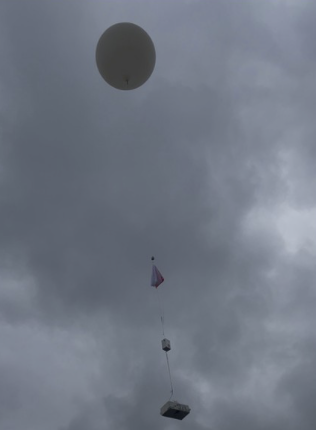
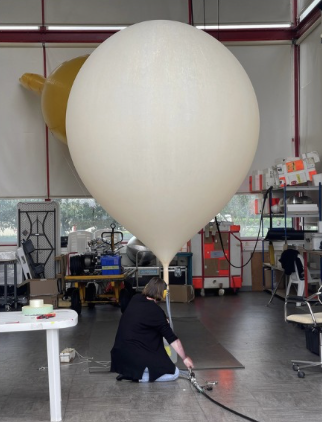
It was from the CNES balloon launch center in Aire-sur-l’Adour (Landes) that we successfully completed our first flight demonstration this Tuesday, June 4th. One of our modules, embarked on a stratospheric balloon operated by the CNES and sent to an altitude of 16km, established a direct link with the ground, transmitting an alert message via standard Bluetooth that could be received by any smartphone.
This first successful demonstration is a major breakthrough for us as we develop the world’s first universal population alert network. It also marks the first time such a communication has been established, demonstrating that Bluetooth is not merely a short-range device.
Bluetooth technology serving the first universal population alert network
Founded in 2023, the seeds of LeoBlue were sown during the Covid period. Inspired by the “TousAntiCovid” app, Philippe Lattes, an expert in the space industry, wondered if the model could be duplicated on a global scale: creating a solution that would connect satellites to all existing smartphones to alert populations in the event of disasters.
Once the idea was formulated, the technological barrier remained to be broken. This is when Guillaume Ferré, a researcher at IMS Bordeaux and a specialist in satellite telecommunications, turned his attention to Bluetooth technology. One patent later, LeoBlue was born with a clear objective: to alert and keep populations informed, even the most isolated or those cut off from terrestrial networks, within 30 minutes.
By using Bluetooth as a communication vector, we make our network sovereign, universal, and resilient. Unlike solutions that require the deployment of a dedicated constellation, we rely on hosting opportunities (payload hosting) aboard satellites currently under construction. This approach considerably reduces our digital footprint and makes LeoBlue one of the most sober solutions on the market.
A message transmitted at an altitude of 16km: a first for standard Bluetooth communication
Known for its efficiency over short distances, Bluetooth technology had never before proven itself in long-range direct downlink for data transmission. By flying one of our modules at an altitude of 16km, we successfully established a direct downlink connection, transmitting and receiving a standard Bluetooth message on a simple smartphone. We thus become the first player to establish this type of link over such a distance.
Only two years after our creation, we have ticked an important box in the development of our population alert network, the first of its kind. Now, it is time for the next step: repeating the operation in orbit, a milestone scheduled for the second half of 2026.
Validating this technological principle in flight was a crucial step for us. With a full deployment of our solution planned for 2030, we are leaving our mark on the field of Bluetooth communications by becoming the first to establish a long-range direct downlink for transmitting messages to smartphones. Beyond the technological success and a respected schedule, this demonstration confirms the feasibility of the project: a decisive element as we launch a fundraising campaign coupled with a crowdfunding operation.